
B2B buying committees now spend weeks researching vendors before anyone fills out a form. That means your content has to rank, resonate, and prove ROI to people who aren't even ready to talk to sales yet. Most teams still treat SEO as a traffic play instead of a revenue engine built for how technical buyers actually evaluate solutions. This guide breaks down the b2b seo strategies that consistently rank content for high-intent decision makers and convert that visibility into pipeline. You'll get the exact frameworks, technical considerations, and publishing workflows that separate teams stuck chasing keywords from those closing enterprise deals in 2026.
Before You Begin: Prerequisites for a B2B SEO Strategy
Tools and Access You'll Need
This guide fits marketing managers, SEO consultants, and founders who need real B2B results, not just theory. Before starting, confirm you have admin access to your CMS, analytics platform, and search console. Skip this and later steps stall out fast.
You'll also want a keyword research tool, a rank tracker, and a way to audit technical SEO issues. Some teams use spreadsheets; others use dedicated software. Either works, as long as the data stays organized and shareable. For a practical reference, check this dev fixture keyword 1 example showing how tracked terms map to published pages.
Aligning Sales, Marketing, and Product Teams
B2B SEO fails when teams work in silos. Sales knows the objections buyers raise. Product knows the feature details. Marketing needs both to write pages that actually convert. Schedule a kickoff meeting before writing a single headline.
Agree on who approves content, who owns keyword targets, and how often you'll review progress. Thirty minutes now saves weeks of rework later. Many teams meet monthly to compare notes and adjust priorities together.
Setting Realistic Timelines and Goals
Record your current rankings, traffic, and lead numbers before changing anything. This baseline lets you prove progress later. Without it, results look vague and hard to defend to leadership.
Set expectations early. B2B SEO often takes three to six months to show measurable movement. Choose two or three specific goals, like ranking improvements or demo requests, instead of chasing every metric at once.
Step 1: Understand What Makes B2B SEO Different
What Is B2B SEO?
B2B SEO means optimizing content for buyers researching solutions for their company, not for themselves. These buyers compare vendors, read case studies, and check pricing pages long before they ever talk to sales. A single guide, like this dev fixture keyword 2 example, might need to speak to five different job titles at once.
B2B SEO vs. B2C SEO: Key Differences
Consumer searches often lead to a quick purchase by one person. B2B searches involve multiple decision makers, longer sales cycles, and smaller search volumes. A keyword with 50 monthly searches can still drive real revenue if it reaches the right buying committee.
| Factor | B2C SEO | B2B SEO |
|---|---|---|
| Buyer count | Single buyer | 3-10 stakeholders |
| Search volume | High | Low to moderate |
| Sales cycle | Minutes to days | Weeks to months |
| Content goal | Drive purchase | Build trust and authority |
On-page, Off-page, and Technical Foundations
Strong B2B SEO still rests on three pillars: on-page relevance, off-page authority, and technical health. On-page work should emphasize thought leadership, since buyers want proof of expertise before they'll book a call. The other pillars support that message without overshadowing it.
Step 2: Research Your Audience and Build Decision-Maker Personas
Identifying the Buying Committee
B2B purchases rarely involve one person. A typical buying committee includes an end user, a budget owner, a technical evaluator, and an executive sponsor. For a Webflow publishing tool, that might mean a content marketing manager, a developer checking API stability, and a founder approving cost.
List every role touching the decision. Note what each person cares about most, whether that's speed, reliability, or reporting. This mapping prevents content that only speaks to one buyer while ignoring everyone else who influences the final sign-off.
Mapping Pain Points to Search Behavior
Each persona searches differently based on their pain point. A marketing operations specialist might search "content publishing workflow audit," while a developer searches "Webflow API integration error." Same product, different language, different intent.
Write down three specific frustrations per persona before touching keyword tools. A freelance consultant testing CMS integrations wants proof of reliability across client sites, not general feature lists. Specificity here shapes better questions later.
Validating Personas with Sales and Support Data
Assumptions need checking. Pull transcripts from sales calls and support tickets to confirm real phrasing and objections. Teams sometimes discover their own testing icon guide dev fixture page already answered a recurring developer question nobody had prioritized.
Do this validation before keyword research starts, not after. Skipping it wastes hours chasing search volume for terms your actual buyers never use.

Step 3: Conduct B2B Keyword Research
Finding Keywords You Already Rank For
Start by auditing what already works. Pull data from Google Search Console to see which queries drive impressions and clicks. Look for striking-distance keywords sitting on page two, since these need small pushes rather than new content. This audit saves time and reveals quick wins before you build anything new. For a broader framework, check A Complete B2B SEO Strategy for 2026 before mapping your next moves.
Sourcing Keywords from Competitors and Publications
Next, mine outside sources for gaps in your own list. This research uncovers terms your buyers actually search for but you haven't targeted yet.
- Run competitor domains through a keyword gap tool to find terms they rank for that you don't.
- Scan industry publications and trade sites for phrasing decision makers use in headlines.
- Check "People Also Ask" boxes for related questions worth answering directly.
- Review competitor blog category pages to spot recurring topic clusters.
- Pull autocomplete suggestions from search bars to catch phrasing variations.
Grouping Keywords by Search Intent
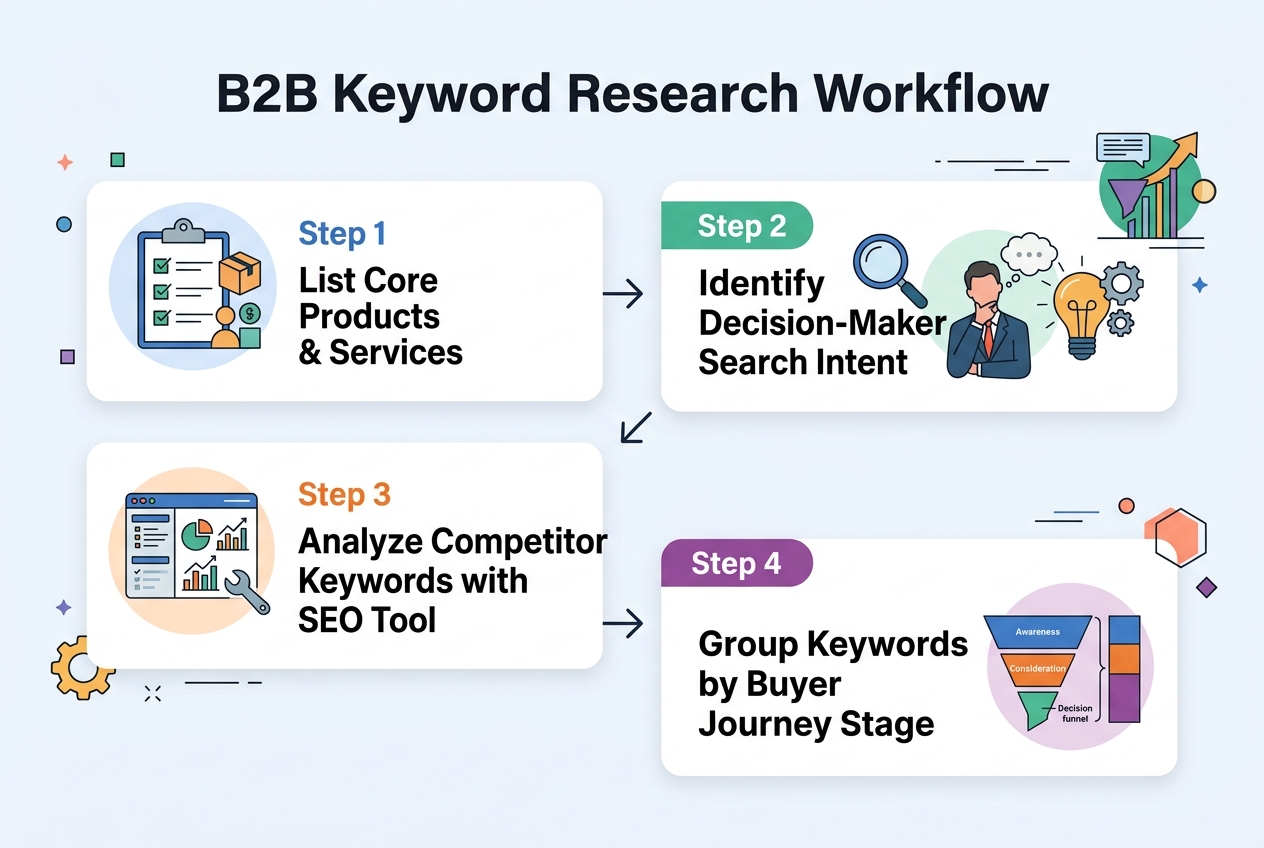
Finally, vet every keyword before adding it to your plan. Sort each term into informational, comparison, or transactional buckets. This grouping keeps your content strategy organized and prevents mismatched pages from targeting the wrong buyer stage later.
Step 4: Map Keywords to the Funnel and Page Types
Bottom-of-Funnel Transactional Keywords
Bottom-of-funnel keywords signal buying intent. Terms like "pricing," "vs.," and "software for [industry]" show a prospect is close to a decision. These keywords belong on pages built to convert, not general blog posts.
Top-of-Funnel Topic Clusters
Top-of-funnel keywords cast a wider net. They cover broad problems your buyer researches early, before they even know your solution exists. Group these into topical pillars, then build supporting articles around each one. This structure builds authority and prepares readers for later-stage content.
Choosing the Right Page Type for Each Keyword
Every keyword cluster needs a matching page type. Mismatches waste traffic and confuse search engines about a page's purpose. The table below shows a simple mapping framework.
| Keyword Type | Funnel Stage | Recommended Page Type | Example Keyword |
|---|---|---|---|
| Comparison | Bottom | Comparison landing page | "[Tool] vs [Tool]" |
| Pricing | Bottom | Pricing or product page | "CRM software pricing" |
| Educational | Top | Pillar blog article | "what is marketing automation" |
| How-to | Middle | Guide or tutorial post | "how to build a lead funnel" |
| Category | Top | Cluster hub page | "B2B SEO strategies overview" |
For a deeper breakdown of funnel-based keyword mapping, review the B2B SEO Strategy: 2026 Guide, which outlines additional page-type frameworks worth testing.
Step 5: Optimize Product and Service Pages
Structuring Pages Around Buyer Questions
Product and service pages should answer real questions, not just describe features. Buyers want to know pricing ranges, implementation timelines, and what problem the tool actually solves. Structure each page around these questions using clear subheadings. This is the core of buyer-intent alignment, and it keeps visitors reading instead of bouncing back to search results.
Start with the problem the buyer faces. Then explain how the offering solves it, step by step. A page for an integration tool, for example, might address "how long does setup take" before discussing advanced features. Order matters as much as content.
Adding Trust Signals and Case Evidence
Decision makers hesitate when pages feel vague. Address objections directly, such as security concerns, contract length, or switching costs. Naming the objection builds credibility faster than avoiding it. This approach mirrors B2B SEO Best Practices for Building Trust, Authority, & ..., which stresses transparency over polish.
Support every claim with proof. Use specific numbers, like "reduced publishing time by 40% across 12 sites," rather than vague praise. Case evidence turns skeptical readers into leads.
Technical On-Page Elements That Matter
Title tags should include the service name and a clear benefit. Meta descriptions need a specific outcome, not generic marketing language. Schema markup for services or products helps search engines display accurate details, improving click-through rates from decision makers scanning results quickly.
Internal links from blog content to relevant service pages also help. They guide researchers from early-stage questions toward pages built for evaluation and comparison.
Step 6: Build a B2B Content and Blog Strategy
Defining High-Value B2B Content
B2B buyers research for weeks before they talk to sales. Your blog needs to earn trust during that research phase. High-value content answers real questions with real evidence, not fluff. For a deeper foundation, check The Beginner's Guide to B2B SEO Strategy in 2026 before mapping out your editorial calendar.
Precision, Personalization, and Depth in Practice
Generic posts rarely convert decision makers. They want specifics tied to their industry and role. Focus on these habits to raise content quality:
- Write toward one buyer persona per article instead of trying to please every reader at once.
- Include real numbers, benchmarks, or case data pulled from actual projects or client work.
- Address objections a procurement or finance stakeholder would raise before approving a purchase.
- Show your process step by step, so readers see the thinking, not just the conclusion.
- Update older posts with fresh examples instead of publishing another shallow overview.
Repurposing Content Across Formats
One deep article can fuel several formats. Turn a long guide into a slide deck, a short video, or a checklist for sales teams. This stretches your research budget further. It also gives prospects more ways to absorb the same expertise, whether they read, watch, or skim.
Step 7: Strengthen Authority with Off-Page and Technical SEO
Link Building for B2B Audiences
Links still signal trust to search engines. For B2B brands, the best links come from original data and real partnerships, not mass outreach emails. Publishing a small industry survey or benchmark report gives journalists and bloggers something worth citing.
Co-marketing with complementary vendors also works well. A software company might partner with a consultancy to publish joint research, earning links from both audiences. This guide on B2B SEO Strategy: A Complete Step-by-Step Guide breaks down more outreach tactics worth testing.
Technical SEO Health Checks
Authority means nothing if bots can't crawl the site. Run a quarterly audit checking for broken links, orphaned pages, and blocked resources in robots.txt. Fix these issues before they compound.
Site speed matters too. A homepage loading in under two seconds keeps visitors and crawlers happy. Compress images, remove unused scripts, and test mobile performance monthly. Small fixes prevent big ranking losses.
Building Topical Authority Over Time
Search engines reward sites that cover a subject deeply, not just once. Building a consistent topical footprint means publishing related articles, updating old posts, and interlinking them clearly.
Over months, this creates a recognizable content cluster. Google starts trusting the domain as a reliable source on that topic, which improves rankings across the entire cluster, not just single pages.
Step 8: Adapt to AI Search and Zero-Click Trends
Optimizing for Google and LLM-Based Answers
Search results now include AI overviews, chatbot summaries, and traditional links. Buyers often get answers without visiting a website. This means fewer clicks from the results page, even when your content ranks well. Treat this shift as a change in behavior, not a failure of your strategy.
Write content that answers questions directly and clearly. Use plain language early in each section. This helps both Google's algorithm and large language models pull accurate summaries from your pages. For a deeper look at how B2B search behavior differs from consumer search, see B2B SEO: The Complete Guide.
Structure matters here. Short paragraphs, clear headers, and defined terms make extraction easier for AI systems scanning your page.
Structuring Content for AI Extraction
AI answer engines favor content with clear structure. Use numbered steps, short definitions, and direct statements near the top of each section. Avoid burying key facts in long paragraphs.
Add FAQ sections with concise answers. Keep each answer under three sentences. This format matches how many AI tools extract and summarize content for users searching by voice or chat.
Measuring Visibility in a Zero-Click World
Click-through rate no longer tells the full story. Track brand mentions in AI answers, impressions in search consoles, and share-of-voice for target keywords. These metrics show visibility even when clicks stay flat.
Monitor referral traffic patterns monthly. A steady rise in branded search often signals that AI summaries are building awareness before the click even happens.
Step 9: Measure Results and Maintain Momentum
Metrics That Matter Beyond Rankings
Rankings feel good, but they don't pay bills. Pipeline-relevant metrics matter more. Track assisted conversions, demo requests, and content-to-opportunity rates. A page ranking first for a keyword with zero business fit is wasted effort. Look at how organic traffic moves leads through your funnel, not just how many visitors arrive.
Auditing and Refreshing Existing Content
Old content decays. Facts go stale, competitors publish better pages, and search intent shifts. Set a schedule to audit your top-performing and underperforming pages every quarter. For a deeper framework on aligning audits with broader goals, see How to Devise a Winning B2B SEO Strategy.
| Review Task | Frequency | Owner |
|---|---|---|
| Traffic and conversion audit | Monthly | Marketing ops |
| Content refresh (top 20 pages) | Quarterly | Content lead |
| Persona and keyword revalidation | Twice yearly | SEO consultant |
| Full technical SEO audit | Annually | Developer/agency |
Building a Sustainable Review Cadence
Markets shift. Buyer titles change, new competitors appear, and keywords evolve. Revisit personas twice a year so your targeting stays accurate. Small, steady reviews beat rare, massive overhauls.
Putting Your B2B SEO Strategies Into Practice
Recap: The Full Step-by-Step Sequence
Nine steps make up this system. You start by understanding what makes B2B buying different. Then you build decision-maker personas, research keywords, and map those keywords to funnel stages and page types. From there, you optimize product and service pages, build a content engine, strengthen authority through technical and off-page work, adapt to AI search, and measure results.
Each step builds on the last one. Skipping ahead often creates weak foundations. A page optimized without persona research, for example, targets the wrong questions. Following the order protects your time and budget.
Common Pitfalls to Avoid
The biggest mistake is treating SEO as a project instead of a habit. Consistency beats one-off wins every time. One optimized page won't outrank a competitor who publishes updated content every month for a year.
Teams also stop measuring too soon. Rankings often take 4 to 6 months to show movement, especially for competitive B2B terms. Abandoning a strategy after 60 days wastes the groundwork already laid.
Another common error is ignoring internal alignment. Sales, product, and marketing teams need shared visibility into which pages target which buyer stage. Without that, content gets duplicated or contradicts itself.
Next Steps for Getting Started
Start small. Pick one funnel stage, one persona, and one page type. Apply the full sequence to that single asset before scaling.
Set a recurring content and review cadence, monthly at minimum. Track rankings, organic traffic, and lead quality together, not in isolation.
Revisit older pages every quarter. Update statistics, refresh keywords, and check technical health. Steady maintenance keeps your B2B presence competitive as search behavior keeps shifting.
If you're curious to see how these kinds of B2B SEO strategies come together in practice, take a look at RankPush Test Blog, a demo blog built to test RankPush's Webflow publishing integration, covering everything from SEO and content marketing to how automated publishing pipelines actually work behind the scenes. Swing by and explore a few posts, or book a quick chat if you'd like to see the pipeline in action for your own site.