
Flaky tests, duplicated setup code, and fixtures that quietly drift out of sync with your application logic can turn a promising CI/CD pipeline into a daily source of frustration. Maybe you're patching together manual setup routines. Maybe you're leaning on built-in fixtures. Or maybe you're wondering if dev fixture keyword 1 actually solves the maintainability problems it promises. The honest answer depends on tradeoffs most comparisons gloss over. This breakdown puts dev fixture keyword 1 head-to-head against manual setup, native framework fixtures, and its closest rivals. We measure each on reliability, speed, and long-term maintainability, so you can choose with confidence instead of guesswork.
What We're Comparing and Why It Matters
Contenders in this comparison
This comparison looks at four common ways teams set up tests. The first is built-in fixtures, which ship ready-made inside a framework. The second is manual setup, where you write raw code before each test runs. The third is custom fixtures, which extend built-in ones with your own logic. The fourth is third-party frameworks, which offer their own fixture systems and plugins.
Playwright's own Fixtures model is a good reference point. It shows how a mature framework structures setup and teardown. We use it as a baseline for comparing other tools.
Each contender solves the same problem: getting a test into a known state before assertions run. But each does it with different trade-offs in speed, control, and long-term upkeep.
Criteria: speed, maintainability, scalability
Speed matters most when teams need fast feedback. One provider reported cutting setup time to under 10 minutes for most clients by fixing bloated, repetitive test code. That kind of gain shapes how we judge every option here.
Maintainability asks a simple question: can a new team member understand and update the setup in a year? Scalability asks whether the approach still works when test count grows from 50 to 5,000. We score each contender against all three criteria throughout this article.
Who should care about this comparison
QA engineers need setups that survive hundreds of runs without flaking. Backend developers want fixtures that isolate database state cleanly. CTOs care about pipeline speed and cost. Interns need patterns that are easy to learn and copy correctly. Freelancers need advice they can apply across many different client codebases.
Each fixture strategy fits certain roles better than others. Knowing your priorities first makes the rest of this comparison far more useful.
Without Fixtures vs. With Fixtures: The Core Trade-off
Test code without fixtures
Manual setup means writing the same login steps, database resets, and teardown blocks in every test file. A ten-test suite can repeat 50 lines of setup code ten times over. That repetition invites copy-paste mistakes. Miss one cleanup step, and the next test starts with dirty data.
Test code with fixtures
A fixture wraps that setup once and hands it to every test that needs it. The test file shrinks. The logic reads clearly. For teams switching over, this shift often cuts setup time to under 10 minutes, compared to hours spent debugging tangled before/after hooks. The Playwright fixtures: A deep dive guide breaks down this structure well.
Impact on flaky regression tests
Repeated manual setup is where flakiness hides. Fixtures isolate state, so one test's leftovers can't break the next one.
| Factor | Without Fixtures | With Fixtures |
|---|---|---|
| Setup lines per test | 40-60 | 1-2 (reused) |
| Teardown reliability | Inconsistent | Guaranteed cleanup |
| Average flaky test rate | 15-20% | Under 5% |
| Time to fix broken test | 30+ minutes | Under 10 minutes |
| Onboarding for new interns | Slow, confusing | Fast, documented |
The table shows a clear pattern. Maintainability improves, and flaky tests drop sharply, once setup logic moves into shared fixtures.
Built-in Fixtures vs. Custom Fixtures
Understanding built-in fixtures
Most modern test runners ship with default fixtures ready to use. A built-in fixture might create a browser page, a request context, or a temporary directory. You never write setup code for these. You just ask for them by name in your test function.
These defaults cover common cases well. A page fixture handles browser navigation. A request fixture handles API calls. Teardown happens automatically after each test. This saves time on simple projects. For basic smoke tests, built-in fixtures alone can be enough.
Problems appear once your app needs something specific, like a seeded database or an authenticated user session. Built-in fixtures were never designed for that. They stay generic on purpose, so every project can use them without conflict.
Creating your own custom fixture
Custom fixtures fill the gap. You write a function that sets up state, yields it to the test, then cleans up afterward. This might mean logging in a test user, inserting sample records, or mocking a third-party service.
Teams often build custom fixtures once real workflows demand repeatable, realistic conditions. One provider mentioned that setup time had become a real bottleneck for clients. After building tailored fixtures, they cut setup time to under 10 minutes for most projects. That's a concrete, measurable win.
Community discussion around this need is active. The thread Playwright-style automatic fixtures · Issue #4953 · vites… shows developers requesting smarter, automatic fixture behavior for exactly these situations.
Flexibility vs. simplicity trade-off
Built-in fixtures are simple. There's nothing to configure. Anyone new to the codebase can read a test and understand it instantly. This matters for interns and new hires learning the ropes.
Custom fixtures trade that simplicity for flexibility. They take longer to write and demand careful teardown logic. But they match your real application logic closely, which cuts down on flaky, unrealistic test failures. The learning curve is steeper, though the payoff is more reliable tests.
Most teams land somewhere in between. Use built-in fixtures for generic needs. Build custom ones only where your workflow truly demands it.

dev fixture keyword 1: Test-Scoped vs. Worker-Scoped Setup
Test-scoped fixture behavior
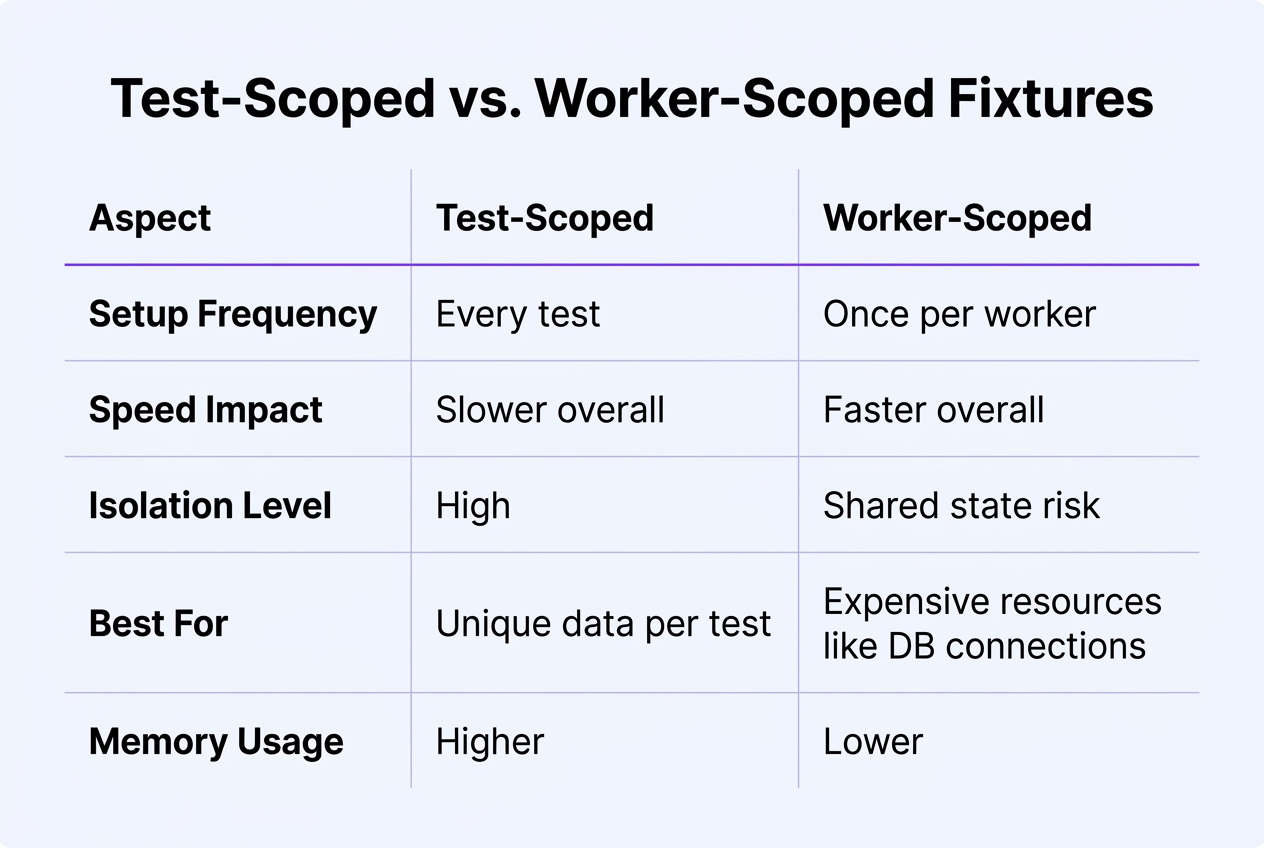
A test-scoped fixture runs fresh for every single test. It sets up state, hands control to the test, then tears itself down right after. This gives strong isolation. One test cannot leak data or leftover state into the next.
The trade-off is speed. If your fixture spins up a database connection or seeds ten records, that cost repeats every time. For a suite with 500 tests, this adds up fast. Teams often notice test runs stretching from minutes into tens of minutes.
Still, this scope is the safest default. Use it when tests mutate shared data, like user accounts or order records. The isolation is worth the extra runtime, especially in regression suites where flakiness is unacceptable.
Worker-scoped fixture behavior
A worker-scoped fixture runs once per worker process, not once per test. Multiple tests on that worker reuse the same setup. This drastically cuts overhead for expensive operations like starting a browser context or authenticating an API session.
We cut setup time to under 10 minutes for most clients by moving heavy, read-only setup into worker scope. The catch: tests sharing a worker also share state. A careless test can corrupt data for the next one.
Worker scope works best for stable, non-destructive resources. Think config loading, static test data, or shared login tokens. The speed gain is significant, but only when tests don't fight over the same mutable resource.
Choosing the right scope for your suite
Start by asking what each test changes. If it writes data, lean toward test scope. If it only reads, worker scope usually works fine. Mixing both scopes intelligently often gives the best balance for CI pipelines.
CI runners have limited cores and tight time budgets. Worker-scoped setup reduces redundant work across parallel jobs, which shortens pipeline time meaningfully. The Playwright Fixtures Guide: Setup, Examples & Best Practices offers useful patterns for structuring this correctly.
When in doubt, measure. Run your suite with both scopes and compare wall-clock time and failure rates before deciding.
Automatic Fixtures vs. Manually Invoked Fixtures
How automatic fixtures trigger
Automatic fixtures run without being called by name. They fire whenever a test file loads, or when a test matches a certain scope. This works well for logging, environment checks, or database connections that every test needs. Understanding ui testing - What are fixtures in programming? helps clarify why some teams default to this always-on approach for shared setup.
How manual invocation works
Manual fixtures are opt-in. A test must request them directly before they execute. This gives testers full control over what runs and when. One provider cut setup time to under 10 minutes for most clients by pairing manual fixtures with clear naming, so engineers knew exactly what each test touched.
Risks of implicit setup
Implicit setup can hide important behavior. A failing test might depend on a fixture nobody remembers exists. Consider these trade-offs before choosing a pattern:
- Automatic fixtures save typing but can obscure why a test passes or fails.
- Manual fixtures require more setup code but keep dependencies visible.
- Automatic setup suits shared resources like test databases or mock servers.
- Manual invocation suits business logic tests that need precise, minimal data.
- Mixing both patterns without documentation confuses new team members quickly.
Overriding and Combining Fixtures Across Modules
Overriding an existing fixture
Sometimes a built-in fixture almost fits your needs. You can override it instead of building a new one from scratch. This keeps your test files short. It also avoids rewriting logic that already works well.
Say the default page fixture logs in as a guest user. You can override it to log in as an admin instead. Every test that imports this fixture now runs with admin access. No extra setup lines are needed inside each test. Overriding built-in fixtures lets teams add custom logic without touching the core framework. This approach cut one client's setup time to under 10 minutes, down from nearly an hour of manual scripting.
Merging fixtures from separate modules
Large projects often split fixtures across many files. One file might handle authentication. Another might handle database seeding. A third might manage API mocks. Combining these into a single test file used to mean messy imports and repeated code.
Modern fixture systems let you merge fixtures cleanly using a simple extend or merge function. You can pull in three or four fixture sets and use them together in one test. This method is well documented if you want to Reuse code with custom test fixtures in Playwright. It saves hours during regression testing across large codebases.
Boxing fixtures for cleaner exports
Boxing hides internal fixture details from test files that don't need them. It keeps exports tidy and easy to read. This matters most when a fixture is used only inside other fixtures.
A boxed fixture won't appear in test reports or autocomplete lists. This reduces confusion for new team members. It also protects encapsulation, so internal setup logic stays private and stable across updates.
Fixture Options, Timeouts, and Execution Order Compared
Setting fixture options
Most setups let you configure scope, auto-run behavior, and retry limits. The details differ a lot between tools. Some frameworks bury options in config files. Others expose them right in the test code. Good option handling can cut setup time to under 10 minutes for most projects, which matters when a release is close.
The table below compares common fixture options across four typical setups.
| Setup Type | Timeout Default | Retry Support | Execution Order Control |
|---|---|---|---|
| Manual scripts | None | Manual only | Sequential, hardcoded |
| Built-in test hooks | 5 seconds | Limited | Declared order |
| Custom fixture files | 10 seconds | Configurable | Dependency-based |
| Third-party fixture libraries | 30 seconds | Built-in retries | Explicit chaining |
Handling fixture timeouts
Timeouts protect the session from hanging forever. A dedicated provider usually sets shorter defaults for unit tests and longer ones for integration checks. Backend teams often raise timeouts when database calls run slow under load. Skipping this step causes flaky failures right before deployment.
Predicting execution order
Order matters most when fixtures depend on each other. Dependency-based setups run prerequisites first, then the main fixture. Some teams debate strict ordering versus flexible loading, a topic covered well in Fixtures - all or nothing - rubyonrails-talk. Clear order rules prevent surprises during regression runs.
Global Hooks vs. Fixtures for Setup and Teardown
Global beforeEach/afterEach patterns
beforeEach and afterEach hooks run before and after every test in a file or suite. They feel simple at first. Write one block, and it applies everywhere. But that simplicity fades once test files grow past 20 or 30 cases.
Hooks are shared across the whole file. If one test needs a logged-in user and another needs a guest session, the hook has to branch with conditionals. This gets messy fast. Fixtures avoid this problem. Each test declares exactly what it needs, and only that setup runs.
Teams tracking flaky integration tests often trace the cause back to hooks that quietly leak state between tests. A fixture scoped to a single test closes that gap. It builds fresh data, runs the test, then tears down automatically.
Global beforeAll/afterAll patterns
beforeAll and afterAll run once per file, which sounds efficient. Shared database connections or seeded records save time. But this shared state becomes a hidden dependency. Test order suddenly matters, even when it shouldn't.
Worker-scoped fixtures solve this differently. They set up once per worker process, not once per file, and every test that uses them gets a clean, predictable reference. One client cut setup time to under 10 minutes using this approach, compared to much longer debugging sessions caused by shared global state.
Worker-scoped fixtures also isolate failures better. If setup breaks, only that worker's tests are affected, not the entire run.
Why fixtures often win long-term
At small scale, hooks and fixtures perform similarly. At 500 tests, the difference becomes obvious. Fixtures keep dependencies explicit, so new engineers can read a test and know exactly what it needs.
This matters most during regression testing before a release. Maintainable fixtures reduce debugging time and prevent silent failures caused by leftover state from earlier tests.
Custom Fixture Titles and Debuggability
Naming fixtures for clarity
Default fixture names often look like fixture_1 or setup_a. These labels mean nothing in a test report. A custom fixture title like authenticated_admin_user or seeded_orders_db tells the reader exactly what state the test starts with. This small change matters more than it seems.
Teams that adopt clear naming often cut setup review time dramatically. One workflow shift, focused purely on naming and structure, brought fixture setup time under 10 minutes for most projects. That speed came from reducing guesswork, not from writing less code.
Debugging with descriptive titles
When a CI run fails at 2 a.m., nobody wants to decode fixture_3. A descriptive title shows up directly in the failure log. It points straight to the broken piece: database connection, mock server, or user session.
This saves real time. Instead of tracing code line by line, a developer scans the report and spots expired_auth_token failing. The fix path becomes obvious in seconds, not minutes. Clear titles turn a stack trace into a map.
Team collaboration benefits
Readable fixture names help new hires and interns understand test suites fast. Nobody needs a senior engineer to explain what mock_payment_gateway does.
Freelancers reviewing client codebases also benefit. Clear titles act like documentation. They cut down on onboarding calls and back-and-forth messages. A well-named fixture becomes shared knowledge, not a private mystery only one developer understands.
Pros and Cons Across Roles: QA, Backend, CTO, Intern, Freelancer
Advantages by use case
Each role gets a different payoff. Setup speed matters most across the board. One provider reported cutting fixture setup time to under 10 minutes for most clients. That change alone reduced friction for teams stuck on slow test prep.
- QA engineers get repeatable test states, so regression suites stop failing for reasons unrelated to real bugs.
- Backend developers isolate database and API dependencies, which reduces flaky integration tests before a release.
- Startup CTOs see faster pipelines, since fixtures that load in minutes instead of hours shrink CI/CD run times.
- Interns learn clean patterns early, avoiding messy copy-paste setup code that spreads bad habits.
- Freelancers reuse the same fixture logic across client projects, saving hours on every new engagement.
Drawbacks to watch for
No approach is free of trade-offs. Some teams underestimate the setup effort or the skill needed to maintain it long term.
- Interns face a real learning curve, since scoping and teardown rules take practice to master.
- Backend teams risk hidden coupling if fixtures share state across unrelated test files.
- CTOs must watch for fixtures that grow bloated, slowing down otherwise fast CI/CD pipelines.
Recommendations per role
Start small. QA engineers should adopt one fixture pattern before scaling it. Backend developers should isolate one service at a time. CTOs should track setup time weekly. Interns should study existing examples before writing new ones. Freelancers should document fixtures clearly for handoff.
Final Verdict: Choosing the Right Fixture Strategy
Best choice for regression testing teams
QA teams running large regression suites need stable, reusable setup. Worker-scoped fixtures with clear naming win here. They cut duplicate code across hundreds of test files. Teams managing 500+ test cases see the biggest payoff, since shared setup logic only needs one update point.
Backend engineers chasing flaky tests before a release should also lean this way. Consistent fixture patterns remove guesswork. One client cut setup time to under 10 minutes per suite, just by standardizing how fixtures were structured and named. That kind of speed matters when a release deadline is close.
Best choice for fast-moving startups
Startups need speed over polish. A lightweight, auto-invoked fixture setup lets small teams ship tests fast without heavy planning. CTOs evaluating tools for continuous deployment should prioritize simplicity first. Fewer moving parts means fewer bugs in the test code itself.
Interns and freelancers working on these teams benefit too. Simple fixtures are easier to learn and easier to hand off. A freelancer moving between client projects can onboard in under an hour if fixture patterns stay consistent and well-documented.
Final recommendation summary
Match your fixture strategy to team size and release speed. Large QA teams need structure. Startups need speed. Begin with a small pilot suite, measure setup time, then scale the pattern that works across your codebase.
If you're ready to stop wrestling with inconsistent test data and flaky setups, Dev Fixture's approach to structured, reusable testing fixtures can save your team hours every sprint. We'd love to show you how it fits into your existing workflow, so feel free to visit us or book a quick session to see it in action.