
Every content team eventually hits the same wall: campaigns that look great in isolation but don't add up to a coherent brand experience. That's usually a framework problem, not a talent problem. 7c marketing fixes this by giving you seven interlocking checkpoints — from customer to communication — that keep every piece of content pulling in the same direction. Here's what it actually looks like in practice. And here's why it matters more in 2026 than it did five years ago.
What Is 7C Marketing? Breaking Down the Framework
Where the 7Cs come from
The 4Ps model — product, price, place, promotion — got built in the 1960s. Back then, businesses could win just by making a good thing and pushing it out the door. It's seller-focused by design. You decide what to sell, what to charge, where to put it, and how to shout about it. Fine for factories. Less fine for anyone competing on trust and relevance today.
The 7Cs flipped that script by asking a simpler question: what does the customer actually experience? Instead of product, you look at customer needs. Instead of price, you look at total cost, including time and effort. Convenience replaces place. Communication replaces promotion, because a real conversation beats a one-way pitch. Consultants at 7C Agency and similar shops have leaned into this shift as brands demand frameworks that start with the reader, not the shelf.
Three more Cs got added along the way to round things out: coordination, credibility, consistency. Together they cover whether your teams work in sync, whether people trust you, and whether that trust holds up visit after visit. That's the whole framework in a nutshell — customer-first, cost-aware, easy to reach, honest in tone, joined-up internally, believable, and steady.
Who uses this framework today
Retailers, SaaS companies, and healthcare providers all use versions of this thinking now, mostly because customers expect it. Nobody wants to be sold at. People want brands that seem to actually understand them. Content-driven outlets feel this pressure hardest, since their entire relationship with an audience runs through words, not shelf space or storefronts.
Editorial teams covering creative fields — design, illustration, photography — lean on the 7Cs almost without naming it. A managing editor thinking about reader needs, publishing cadence, and tone consistency is doing 7C work whether or not they've heard the term. Writers like albin waters build credibility one byline at a time, which is exactly what the framework asks for.
Marketing ops folks, freelance SEO consultants, and founders vetting publishing tools all end up circling back to this same model, because it maps cleanly onto content strategy. It's not a trend. It's just how customer-first brands think now.
The 7Cs vs. the Traditional Marketing Mix (4Ps and 7Ps)
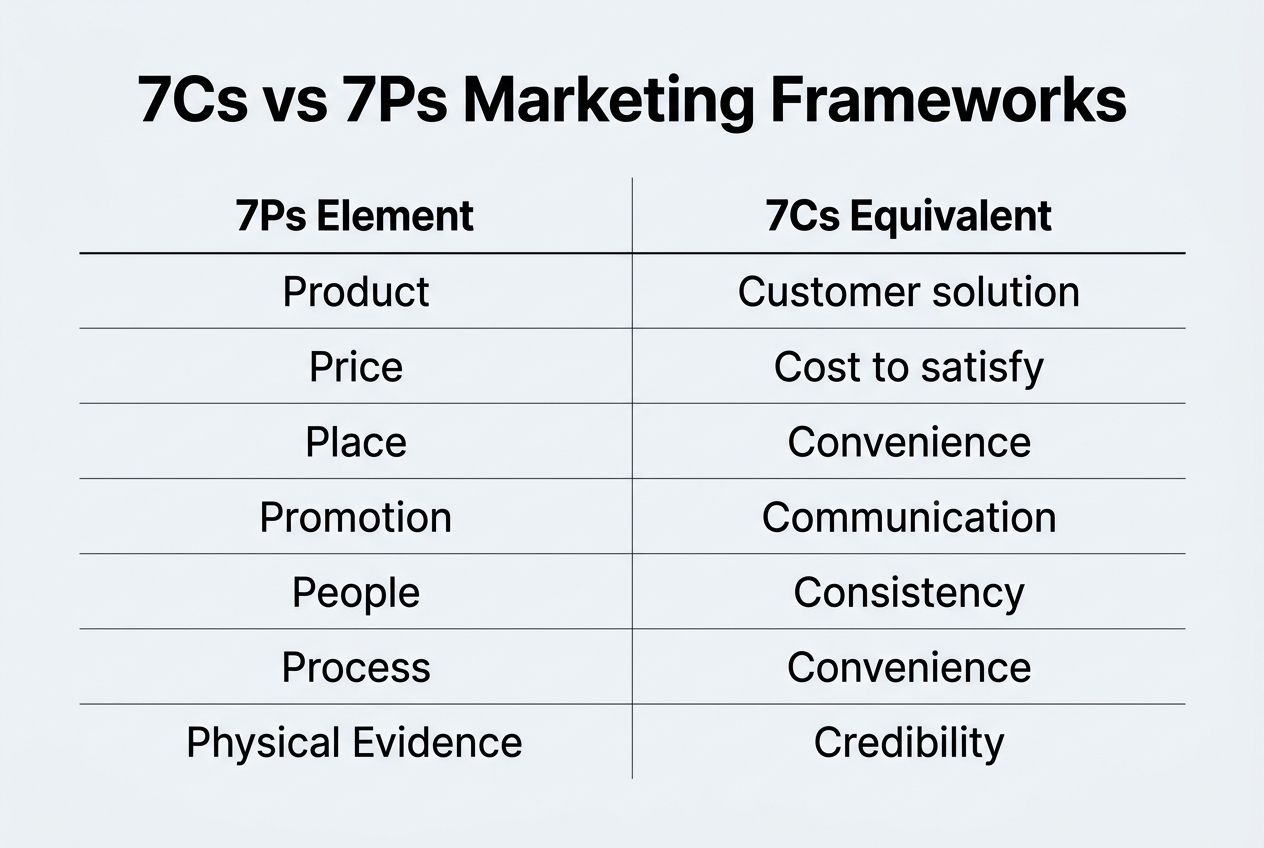
The classic 4Ps got a customer-facing makeover once marketers realized buyers don't think in terms of "product" and "price." They think about what they need, what it costs them in time and effort, and how easy the whole thing is. The 7Ps extension added People, Process, and Physical Evidence to account for service businesses. The 7Cs answer those same three gaps, but reframe them as Coordination, Credibility, and Consistency. Same territory, different lens. One reads like an org chart. The other reads like a promise.
Direct comparison table
Here's the side-by-side breakdown, mapped element for element:
| 4P / 7P Element | 7C Equivalent | What Changes |
|---|---|---|
| Product | Customer | Starts with a need, not a feature list |
| Price | Cost | Includes time, effort, and switching cost, not just dollars |
| Place | Convenience | Access measured by ease, not distribution channels |
| Promotion | Communication | Two-way conversation instead of one-way broadcast |
| People / Process / Physical Evidence | Coordination / Credibility / Consistency | Internal operations reframed as trust signals buyers actually notice |
When to favor one model over the other
If your team plans from the inside out — production costs, staffing, logistics — the 7Ps still work fine as an operations checklist. But if you're mapping a buyer's journey, the 7Cs force you to think like the reader, not the publisher. A content team asking "what does convenience look like for a subscriber" will make different decisions than one asking "where do we place this." For a deeper walk-through of each swap, this breakdown of the C's of Digital Marketing: A Blueprint for Success lays out the logic well. Teams juggling multiple publishing workflows often find it useful to track broader shifts in the space too, and skimming current Content Marketing News can surface patterns worth testing. For a grounded example of how editorial credibility gets built person by person, the profile page for Reta Torphy shows what that looks like in practice. Neither model is wrong. Pick the one that matches how your team actually thinks.
Applying Each C to a Content and Publishing Business
Reader-facing Cs
Start with Customer. A creative-culture publication succeeds only if it knows what readers of animation, architecture, illustration, and photography content actually want from a given visit — a quick trend roundup or a deep feature. Cost here isn't dollars. It's the reader's time and attention, spent scrolling past clutter to find something worth reading. Convenience shows up in categorized sections and a simple newsletter signup, so browsing by discipline doesn't feel like work. If you want to see how this plays out in practice, browsing the latest posts across categories gives a quick sense of how variety and pacing work together on a real site.
Behind-the-scenes Cs
The remaining Cs live behind the page, but readers feel them anyway. Consider what makes a masthead trustworthy and a publishing schedule dependable:
- Communication means running an active back-and-forth on social channels plus a real inquiry line for potential contributors, not a one-way broadcast.
- Coordination looks like a visible team — a cofounder acting as editor in chief, managing editors, senior writers — each credited by name on bylines.
- Credibility comes from a physical address readers can look up, named leadership instead of anonymous staff, and separate contact channels for press versus general questions.
- Consistency is the unglamorous one: a steady publishing cadence across every category, plus a newsletter that actually arrives on schedule.
- Together these behind-the-scenes Cs build the kind of trust that turns a casual visitor into a repeat reader.
None of this is flashy. It's mostly discipline, applied consistently. If you're studying the framework itself rather than its application, working through the 7C Online Marketing Framework Flashcards is a fast way to lock in the terms before auditing a real content operation. Skip any one of these Cs and the whole thing feels a little off, even if readers can't say why.
Do Small Businesses and Startups Need Both 7P and 7C Frameworks?
A simple decision path for lean teams
Short answer: no, you don't need to run both at once. Most small teams are stretched thin already. Trying to audit every channel against 7Cs and 7Ps simultaneously is a good way to produce a lot of spreadsheets and very little content. Pick one lens based on what problem you're actually solving right now, and save the other for later.
If the question is about messaging, tone, or whether readers are actually engaging with what you publish, the 7Cs are the better tool. They're built for exactly that: customer-facing clarity over operational mechanics. A founder testing a new blog or newsletter should ask whether the content, cost, convenience, and communication are landing with readers before worrying about staffing or process. The 7Ps still matter, though, once you're delivering an actual service — scheduling, fulfillment, the people executing the work. A studio offering paid consultations or retainer work needs that operational structure; a content site publishing articles mostly doesn't, at least not at the same depth.
Plenty of teams find useful middle ground by exploring how the 7Cs integrate with inbound marketing before deciding whether operational planning even applies to them. That's the real filter: are you selling a service with delivery logistics, or are you publishing and communicating? One needs both frameworks eventually. The other mostly just needs the 7Cs, done well, and left alone. Overbuilding process for a two-person blog is just busywork with extra steps.
Practically, start with 7Cs for content strategy — audit your reader experience, your channels, your conversation with the audience. Layer in 7Ps only once you're running a service business with real delivery mechanics: booking, staffing, physical or scheduled sessions. This sequencing matters for founders comparing tools and consultants evaluating client strategies alike, since recommending the wrong framework at the wrong stage wastes budget nobody was excited to spend in the first place.

7C Marketing Framework: Strengths and Limitations
Where the framework excels
The 7C model shines when a brand's whole business is built on trust and ongoing relationships, not one-time transactions. For a publisher, that's the entire game. Because the framework forces you to sit inside the reader's head — what do they need, what do they want to feel — it builds customer empathy directly into editorial planning rather than bolting it on later. That's a real advantage for content and community-driven brands, where a subscriber's trust compounds over years, not a single checkout session.
It also sharpens retention thinking: instead of asking "how do we get one more reader," it asks "how do we keep this one." And because editorial teams and marketing teams often speak different languages, the shared vocabulary of the 7Cs gives both sides one framework to argue about reader value inside, instead of past each other. If you want a broader view of how community-first thinking shows up elsewhere, it's worth knowing that marketers already track this across channels — plenty of teams have found that learning the 7 Cs of social media marketing sharpens exactly this kind of audience-first thinking.
Where it falls short
Here's the catch: the 7Cs get vague fast if you don't pin numbers to them. "Convenience" without a bounce-rate target is just a nice word. The table below breaks down where it holds up and where it doesn't.
| Scenario | 7C Fit | Why |
|---|---|---|
| Subscriber newsletter growth strategy | Strong | Centers on ongoing value and reader relationship |
| Editorial-marketing alignment meetings | Strong | Shared language around reader value, not just output |
| SaaS product pricing tiers | Weak | Lacks the cost-structure precision of the 4Ps |
| Setting quarterly KPIs per channel | Weak | Each C needs a bolted-on metric to mean anything |
| Community-driven brand positioning | Strong | Built around trust, not transactions |
So use it for relationship-driven decisions. Skip it for pricing spreadsheets. It's a compass, not a calculator — don't ask it to do math.
How to Audit Your Brand Against the 7Cs
Auditing your brand against this framework doesn't need a consultant or a fancy dashboard. It just needs an honest walk-through of your own site, done the way a stranger would experience it. Grab a notebook. You'll be surprised what turns up.
A 7-step audit checklist
Work through these steps in order — each one builds on the last, and skipping ahead usually means missing something obvious later.
- Step 1: map your current customer personas against your existing content categories, and flag any topic areas where the two don't line up.
- Step 2: evaluate the true cost of engagement — how much time, attention, or subscription friction you're asking of someone before they get value back.
- Step 3: test convenience directly by navigating your own site on a phone, checking whether categorization actually helps or just adds clicks.
- Step 4: review your communication channels, including social presence and whether press or contributor inquiries have a clear, dedicated point of contact.
- Step 5: assess internal coordination by asking whether your team structure is visible and whether anyone is accountable for a given piece of content.
- Step 6: check credibility signals — a real physical address, named staff, and transparent policies all matter more than most teams assume.
- Step 7: measure consistency across publishing frequency, newsletter cadence, and tone, since gaps here quietly erode trust over time.
Turning audit findings into an action plan
Once you've got your seven findings written down, rank them by impact, not effort. Fixing convenience issues usually pays off faster than rebuilding your tone guide. If you're weighing this framework against a more traditional model, learning how the two approaches actually differ in practice helps you decide which gaps deserve attention first. Set a 90-day recheck. That's it — no need to overthink it.
7C Marketing FAQs
Common questions answered
Real-world 7C thinking shows up more often than people notice. A creative-industry publication that groups articles by discipline, keeps a visible masthead, and offers separate contact lines for readers, press, and contributors is quietly running a customer-first, communication-heavy version of the framework. A local bakery that lets you order online, pick up curbside, and get a text when the loaves are ready is doing the same thing with convenience and channel. None of it needs a fancy name. It's just structure that respects the customer's time.
Why does this matter for trust? Simple: consistency builds credibility, and inconsistency erodes it fast. If your pricing feels fair one month and confusing the next, or your support channel goes quiet after launch, readers and customers notice within a visit or two. People interested in creative fields especially — designers, illustrators, photographers — expect polish and honesty in equal measure, because their own work depends on both.
How often should you revisit alignment? At minimum, twice a year, and immediately after any major product, pricing, or team change. Fast-growing teams should check quarterly. Things drift faster than you'd think. If you're mapping out a broader rollout plan, it's worth looking at real practitioner notes on 7C's for Digital Marketing Services Strategy 2025 before you lock in a review schedule.
As for 7C versus CX strategy: they overlap but aren't twins. 7C is a planning lens — seven categories to check when building or auditing a marketing approach. CX is the lived result: how a person actually feels moving through your site, your emails, your support replies. Think of 7C as the blueprint and CX as the walkthrough. You need both, but they answer different questions.
If the 7 C's of marketing feel like a lot to juggle alone, it helps to see how a real creative outlet puts clarity and consistency into practice—stop by RankPush Test Blog, the Brooklyn-based design and culture magazine at 144 N 7th St. #536, to see their editorial team in action, or reach out through their contributor inquiry channel to start a conversation.