
Search rankings keep slipping toward sites that read less like content mills and more like trusted sources — and you've noticed. Publishing more posts isn't the fix. Authority blogging is what actually moves the needle in 2026, but building that trust at scale, especially through automated pipelines feeding platforms like Webflow, takes a deliberate system rather than guesswork. This guide breaks down exactly how to build that system, from editorial standards to the integrations that keep it running without sacrificing credibility.
What Authority Blogging Really Means Today
Authority vs. Popularity: Why They're Not the Same
Posting three times a week doesn't make you an authority. It just makes you noisy. Real authority comes from recognized expertise, consistent depth, and readers trusting you on a specific set of topics — not from volume. A site that publishes ten thin posts a month will always lose, long-term, to one that publishes four sharp ones. Trust gets earned in a niche. It doesn't spread thin across everything.
Search engines and readers actually want the same thing here, which is convenient. Both reward demonstrated experience over generic filler — someone who's clearly done the work, not just summarized it. If you're building out something like a regional guide, look at an existing la design guide. It shows you what specialist, ground-level coverage actually looks like versus a rehashed listicle.
Niche magazines covering design, illustration, or photography earn authority precisely because they stay in their lane and go deep. Categorized, specialist coverage signals to readers that you know the terrain. Signals of that authority show up in concrete ways: named bylines, a visible editorial structure, transparent contact channels, and cited expertise throughout the work. Anyone anonymous, with no clear structure behind them, has a much harder climb — and honestly, they should.
Laying the Foundation Before You Publish
Picking a Niche That Can Sustain Years of Content
Before you write a single post, get honest about scope. Trying to cover every creative discipline at once sounds ambitious. Usually it just means you cover none of them well. A defensible niche is one where you can credibly publish for three, five, ten years without running dry — think animation and motion graphics, or graphic design and illustration paired together, rather than "all things creative."
Narrow doesn't mean small. A tight niche still has room for hundreds of angles: technique breakdowns, studio profiles, historical retrospectives, tool reviews. What it does is give readers a reason to trust you as the source, not just a source. That trust is the entire point of building an authority site in the first place.
Test your niche idea against a blunt question: could you list 50 story ideas in it right now, off the top of your head? If not, it's probably too thin. Don't force it. Pick something with actual depth instead.
Structuring Categories Like a Real Publication
Once you've settled on scope, organize it the way an actual magazine would — clear verticals like animation, architecture, graphic design, illustration, and photography, each with its own identity but a shared editorial voice tying them together. This isn't busywork. Categories shape your navigation, your URL structure, and eventually how search engines understand what your site is about.
Set editorial standards before you publish post one: a style guide for voice, a fact-checking process, and clear contributor guidelines so freelance pieces don't read like they came from five different sites. Some teams handle this with a strict editorial review stage before anything goes live, which keeps quality consistent even as volume grows. It's a small process decision that pays off for years.
Finally, pick a cadence you can actually sustain — weekly, twice a week, whatever fits your resources — and stick to it. A publication that posts four times a week for a month, then vanishes for six, teaches readers not to expect anything from you. Consistency, not volume, builds the habit.
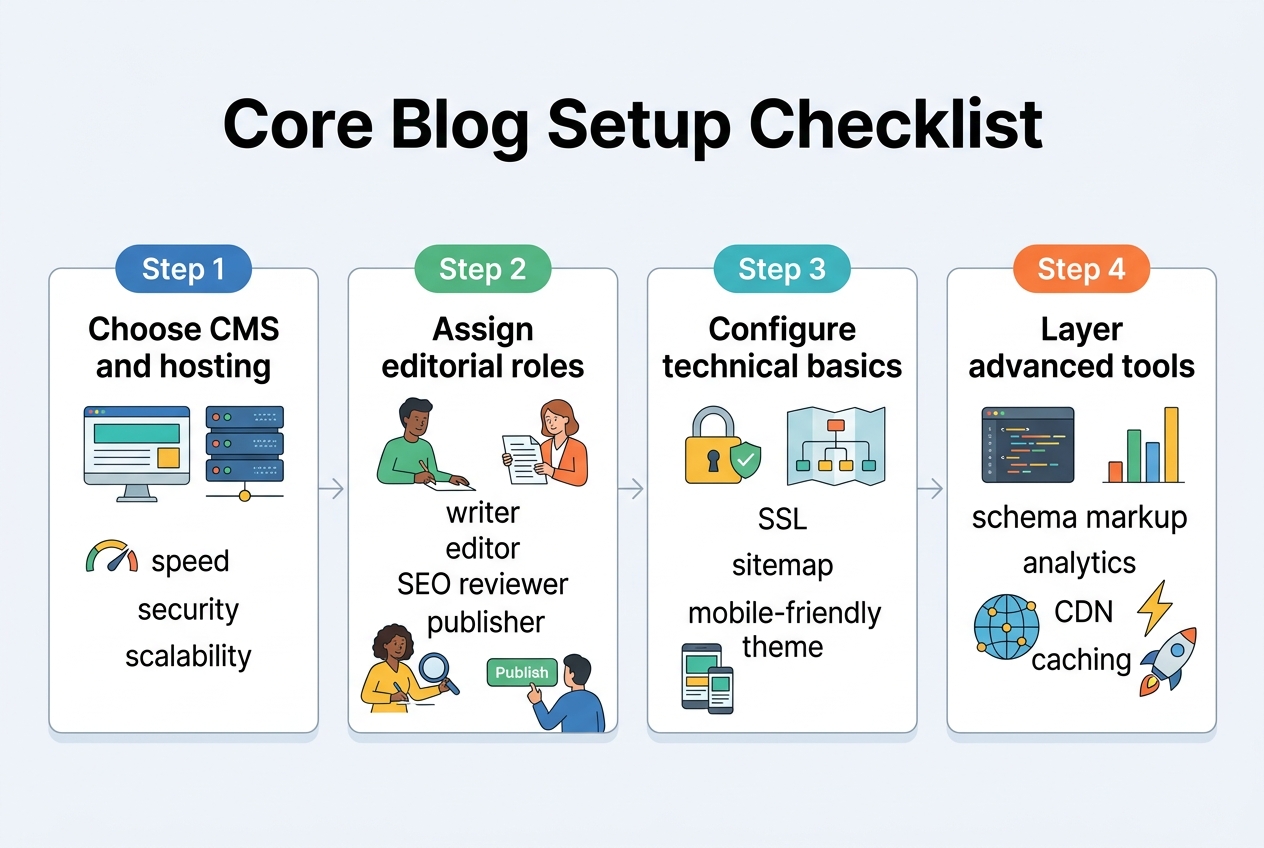
Core Setup: Site, Editorial Roles, and Technical Basics vs. Advanced
Every blog starts somewhere basic. A CMS, some categories, an author bio field, a newsletter box. That's fine for a hobby site. But a real editorial operation looks different: named roles, dedicated inquiry lines, a repeatable process for bringing in outside writers. The gap between the two isn't really about budget. It's about whether anyone outside your team can verify who's actually behind the content.
Here's a side-by-side of what changes as you move from minimal to advanced.
| Element | Minimal Setup | Full Editorial Operation |
|---|---|---|
| Content structure | Flat blog, few categories | Categorized verticals (design, photography, architecture, etc.) |
| Author info | Generic byline or none | Named editors and writers with bios and titles |
| Contact options | Single contact form | Separate channels for press, contributors, general inquiries |
| Contributor process | Ad hoc email submissions | Structured pitch-to-publish workflow with editorial review |
| Business presence | No verifiable address | Physical address and public team roster |
Minimal Setup vs. Full Editorial Operation
A minimal setup gets you publishing fast, and that's not nothing. But readers and search engines both look for signals that real people stand behind the work. A masthead listing a cofounder and editor in chief, alongside managing editors and senior writers, does that job. So does a bio page — something like a senior writer's published bio tells visitors there's an actual person with a track record, not a content farm. Pair that with a real street address and separate press and contributor inboxes, and you've built trust most sites never bother earning.

Building the Brand Behind the Blog
Making Your Editorial Team Visible
Trust doesn't come from a logo. It comes from consistency, category after category, post after post. If your architecture coverage reads nothing like your photography features, readers notice. So does anyone evaluating your site's credibility. A shared tone, shared visual rules, and a shared sense of editorial judgment tell readers there's a real operation behind the byline, not a rotating cast of ghostwriters chasing keywords.
Author pages matter more than most teams admit. A bio with a name, a headshot, a role, and a few past bylines does more for perceived expertise than another paragraph of credentials buried in an about page. Visible bylines signal accountability, and readers, and search engines, reward that. If you're starting from zero, this guide to building an authority blog from scratch is a decent place to see how team visibility fits the bigger picture.
Your Instagram, Facebook, and Twitter/X presence should sound like the same publication, just in a different room. Same voice, same values, different format. And skip the stock-photo team page. Show real editors making real calls on real deadlines. That's what separates an authority site from a content mill nobody can name a single writer at.
Bringing In Writers and Contributors
No blog builds real authority on one person's voice alone. At some point you'll need outside writers, and that means opening a clear front door for pitches instead of letting them land wherever. A dedicated contributor inbox, separate from general inquiries and press requests, keeps things sane and signals you take submissions seriously. It's a small setup step with a big payoff: fewer missed pitches, fewer awkward "wrong department" replies.
What to Look for in a Contributor Pitch
Not every pitch deserves a yes. Some brilliant writers just aren't a fit for your beat, and that's fine. As one honest breakdown of authority-building efforts makes clear, consistency and voice matter more than raw talent alone. Before saying yes, run each pitch through a short checklist:
- Check the portfolio for published work that shows range and depth, not just one lucky viral piece.
- Confirm niche fit — a photography expert pitching an architecture deep-dive is a mismatch, however well they write.
- Read a sample paragraph aloud and ask if it sounds like your publication, or like someone else's.
- Look for evidence they've done original reporting or interviews, not just aggregated other people's ideas.
- Note how they respond to feedback in the pitch email itself — defensiveness now means friction later.
Once someone's in, onboarding matters. Hand over a style guide, review the first pitch closely, and expect two or three editing rounds before it clicks. Many teams also study broader digital marketing services guidance to see how editorial and promotion teams coordinate. Keep a healthy mix of staff writers and guests. Staff give consistency. Guests give fresh angles you simply won't generate in-house.
Growing Reach: Newsletters, Community, and Repeat Visitors
Why Repeat Visitors Matter More Than Pageviews
A newsletter is still the best tool you have for turning a one-time reader into someone who actually comes back. Think about it: a person lands on an article from a search result, reads it, and leaves. Unless you capture their email, that's it. You never see them again. A well-placed signup form, paired with a clear reason to subscribe — early access, curated picks, a behind-the-scenes note from an editor — converts that fleeting visit into an ongoing relationship. That's the whole game.
Community engagement matters just as much, even though it's harder to measure. Comment sections, social shares, and reader features all signal that people care enough to participate, not just skim. Featuring a reader's project or repost, or replying to comments personally, builds a sense of belonging that algorithms can't fake. In fact, establishing credibility within a niche often depends more on this kind of visible back-and-forth than on any single viral post.
Here's the blunt truth: a traffic spike from one viral piece proves nothing. Anyone can get lucky once. What proves authority is people choosing to return week after week, because they trust what they'll find. Track your returning-visitor rate, not just your total sessions. It tells you far more.
Habitual return doesn't happen by accident. It's built through structure. Recurring columns, weekly themed roundups, or a Monday morning digest give readers a reason to check back on a schedule. That predictability, paired with a solid newsletter, is what turns casual readers into a loyal base.
Monetization Options for an Authority Blog
Advertising vs. Reader-Supported Models
Every authority site eventually asks the same question: how do we get paid without wrecking what readers trust us for? There's no single right answer. Some people conflate ad-driven sites with true authority sites, but as this discussion on whether blogging equals building an authority site makes clear, the two aren't the same thing at all. Revenue model is a business decision layered on top of authority, not proof of it.
Here's how the main paths stack up in practice.
| Model | Typical Revenue Range | Trust Risk | Best Fit |
|---|---|---|---|
| Display advertising | Low, scales with volume | Low, but clutters design | High-traffic generalist sites |
| Sponsored features | Moderate to high per piece | Moderate if disclosed poorly | Niche editorial sites |
| Newsletter sponsorships | Moderate, predictable | Low | Engaged subscriber bases |
| Affiliate partnerships | Variable, commission-based | High if recommendations feel forced | Product-focused content |
| Paid memberships | Low volume, high loyalty | Very low | Dedicated niche communities |
A design-focused readership is small compared to general news traffic, but it's dense with people who buy software, tools, and services. That's why niche sponsors pay more per impression than mass-market advertisers ever will. The real risk isn't monetizing — it's monetizing sloppily. Undisclosed sponsorships, forced affiliate links, or ads that clash with editorial voice erode trust fast. Pick the model that fits your audience's actual buying behavior, not the one that's easiest to plug in.
Common Mistakes That Undermine Authority
Red Flags Readers Notice Immediately
Trust erodes fast when the cracks show, and most cracks are visible within the first sixty seconds on a page. Readers aren't reading your mission statement. They're scanning for signs that a real, functioning team is behind what they're looking at. When those signs are missing, they leave. They don't come back to check twice.
- Publishing five posts in one category, then abandoning it for months, which tells readers you started something you couldn't finish.
- Using generic "admin" or "staff" bylines instead of naming actual editors and writers, which makes the whole operation feel faceless.
- Burying or omitting a contact page, so anyone wanting to reach the team, pitch a story, or ask a question hits a dead end.
- Jumping on every passing trend instead of building a consistent point of view readers can recognize post to post.
- Launching a newsletter with fanfare, then letting it go quiet for months, which quietly tells subscribers you've moved on.
- Leaving old, outdated posts uncorrected long after the facts or advice inside them have changed.
None of these mistakes are fatal alone. Stack two or three together, though, and readers draw a quick conclusion: nobody's really running this thing. Reviewing proven keys to establishing your authority as a blogger is a useful gut-check before you assume your site is in good shape. Fix the visible stuff first. It's usually the cheapest repair with the biggest payoff.
What's Next: Keeping Authority as You Scale
A Simple Quarterly Authority Audit
As your team grows, your editorial guidelines can't stay frozen from launch day. Every quarter, pull them out and check whether they still match how your writers actually work. New contributors bring new habits, and if nobody revisits the style guide, tone drifts and quality gets inconsistent fast. This is also a good moment to double check sourcing rules, fact-checking steps, and byline standards. Small fixes here prevent big credibility problems later.
Old posts age quietly, and that's a risk. Set aside time each quarter to review older articles for outdated stats, dead links, or claims that no longer hold up. Prioritize your highest-traffic pages first — those carry the most reputational weight. Because ranking well depends on more than fresh posts alone, learning how blogging builds topical authority helps explain why maintaining depth across a topic matters as much as publishing new content.
Resist the urge to add categories just to look bigger. Expand only when you have real expertise and enough content to back it up. Otherwise you're diluting focus, not building it. Track subscriber growth, contributor quality, and brand mentions over time — those three numbers tell you if the audit is actually working. Vanity metrics lie. These don't.
Authority in the creative space isn't built overnight, but it starts with consistently sharing perspective the way RankPush Test Blog has from their home base at 144 N 7th St. in Brooklyn — right in the heart of a neighborhood that breathes design and culture. If you're ready to build that same kind of trusted voice for your own brand, stop by and see their work firsthand, or reach out to their team to start the conversation.