
Regression suites break for dumb reasons—stale test data, race conditions in setup and teardown, fixtures that pass on your laptop but rot in CI. By 2026 the fix isn't more mocks. It's picking the right foundation. Dev Fixture Keyword 2 has emerged as a serious contender against built-in fixtures, promising faster setup, fewer flaky failures, and less boilerplate across sprawling test suites. Whether you're a QA engineer chasing reliability, a CTO watching pipeline speed, or an intern trying to write tests that won't need a rewrite next quarter, this comparison breaks down which approach actually holds up under regression testing pressure.
What we're comparing and why it matters
Framework-native fixtures vs. custom fixture patterns
Framework-native fixtures come built into your test tool. They handle setup and teardown with almost no configuration. Custom fixture patterns, on the other hand, are hand-built by your team to fit specific workflows—seeding a database, say, or mocking an API response.
Both approaches solve the same problem: they prepare a clean state before each test runs. The difference is control. Native Fixtures save time out of the box, as described in the official Fixtures documentation. Custom patterns give you more flexibility, but they demand upkeep.
We judge both on four criteria: setup speed, maintainability, flakiness, and scalability. These four factors decide whether a testing setup helps a release schedule or drags it down.
Why fixture choice affects flaky tests
Flaky tests fail at random, even when the code is fine. Poor fixture setup is a common culprit. If test data isn't reset properly, one test can pollute the next.
Native fixtures cut this risk with consistent lifecycle rules. Custom fixtures can match that reliability, or beat it, but only with careful design. Sloppy custom code often introduces the exact flakiness teams are trying to avoid.
Who this comparison is for
QA engineers need dependable setups for daily regression runs. Backend developers want fewer false failures before a release. Startup CTOs care about speed across a growing pipeline. Interns benefit from seeing clear, repeatable patterns early. Freelancers need a framework they can confidently recommend to any client.
Dev fixture keyword 2: full breakdown
Creating and registering the fixture
At its core, this pattern wraps setup code in a reusable function, then hands the prepared object straight to your test. You define it once, register it with a test file or config, and every test that needs it just requests it by name. Registration is what makes it discoverable, rather than a plain helper function you have to import by hand every time.
Here's a typical example: a fixture spins up a test database connection, seeds three rows of sample data, then yields the connection object. The test runs its assertions, then control passes back to the fixture for cleanup. This yield-based structure keeps setup and teardown logically paired, which cuts down on forgotten cleanup steps that leak state between tests.
Execution order and dependency resolution
Fixtures can depend on other fixtures. A login fixture might depend on a database fixture, which depends on a config fixture. The test runner resolves this chain automatically, building each dependency before the one that needs it. That saves you from writing manual ordering logic scattered across test files.
Teardown runs in reverse order, closing the last-created resource first. It's a bit like how many local shops handle closing time: last person in locks up first. For deeper technical context on this resolution model, Playwright fixtures: A deep dive lays out the underlying dependency graph clearly.
Common pitfalls when adopting it
New teams often over-nest fixtures, building five-layer dependency chains that make debugging painful. Others forget that fixtures re-run per test by default, which drags down performance across large suites. Watch fixture scope carefully before you scale up test count.
Built-in fixtures vs. custom fixtures: head-to-head
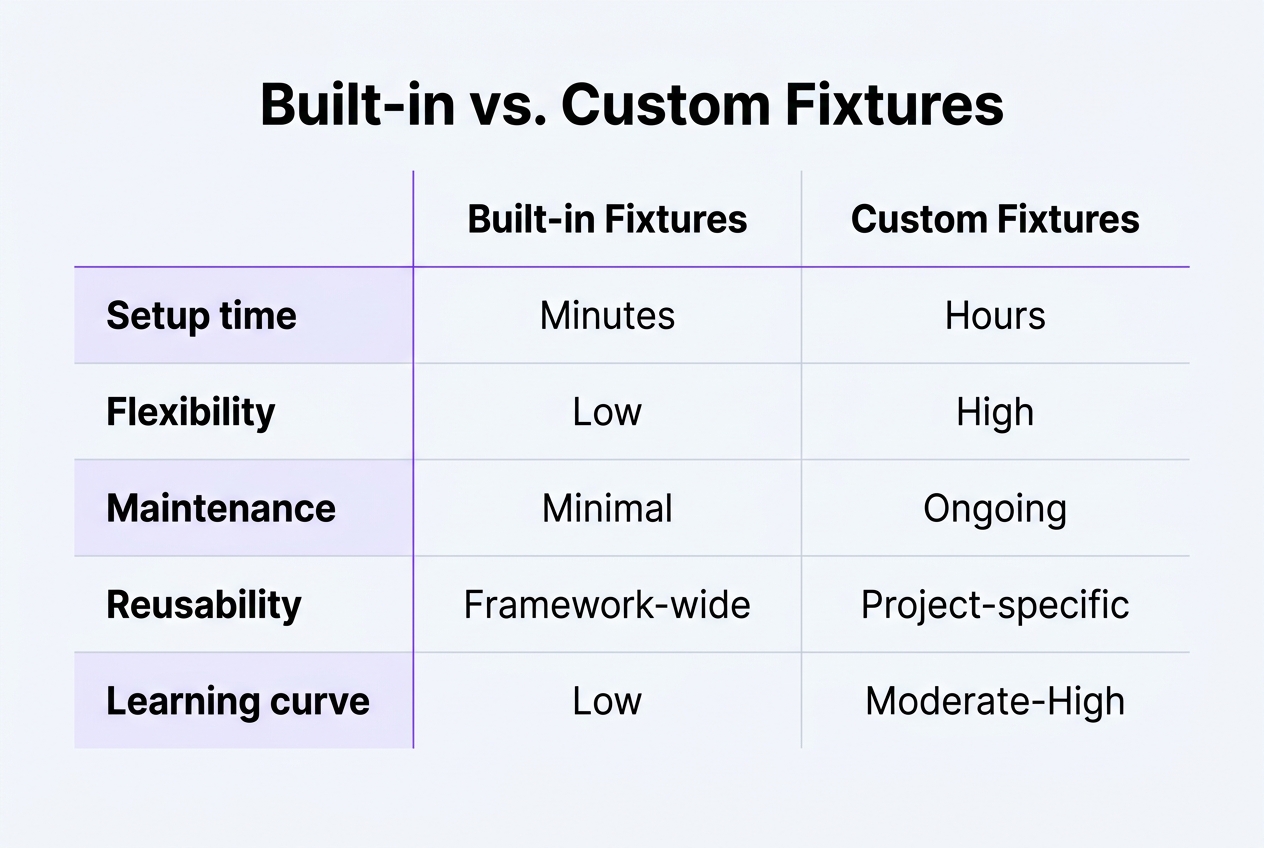
Choosing between built-in and custom setups comes down to speed, flexibility, and how much upkeep your team wants later. The table below lines up both options across the factors that matter most for regression testing.
| Factor | Built-in fixtures | Custom fixtures |
|---|---|---|
| Initial setup time | Minutes; ready out of the box | Hours to days, depending on scope |
| Learning curve | Low; follows framework docs | Moderate; requires design decisions |
| Flexibility for edge cases | Limited | High; built for your app's quirks |
| Speed at scale (100+ tests) | Fast, but can duplicate setup logic | Fast, with shared logic reused across suites |
| Best fit | Small teams, simple apps | Complex, multi-service test suites |
Setup time and boilerplate
Built-ins win early on. You get working test scaffolding without writing a single helper function. Custom fixtures take longer upfront, but they remove repeated code down the line.
Extensibility for complex test suites
Once tests touch multiple databases or mock services, built-ins start to strain. Teams often ask for more automatic behavior, as seen in Playwright-style automatic fixtures · Issue #4953 · vites…. Custom setups handle this kind of thing naturally.
Long-term maintenance cost
Built-ins stay simple, but they can force awkward workarounds. Custom fixtures cost more to build, though they pay off through lower long-term maintenance once suites grow past a few dozen tests.
Worker-scoped vs. test-scoped fixtures
When shared state speeds up suites
Worker-scoped fixtures run once per worker process, not once per test. A login session, a database connection, or a browser instance can be created a single time and reused across dozens of tests. This cuts setup overhead dramatically. A suite with 200 tests might save several minutes if authentication happens once per worker instead of 200 times.
Teams running large regression suites usually see the biggest gains here. If a suite takes 25 minutes with test-scoped setup, switching heavy fixtures to worker scope can shave that down to 15 minutes or less, depending on how expensive the setup step is.
Risks of state leakage across tests
Shared state comes with a cost: state leakage. If one test modifies a shared object, database record, or cookie, the next test in that worker may inherit conditions nobody expected. That's what causes flaky failures that are nearly impossible to reproduce locally.
Looking at how Test Fixtures for Playwright Test | 4 | Axe DevTools® for… structures fixture scope is a useful reference for spotting these hidden dependencies before they cause release-day surprises.
Choosing scope based on test type
Fast, independent unit-style checks usually work fine with worker scope. Tests involving mutable data—order creation, account updates—need test-scoped isolation to stay reliable during parallel CI runs.
A practical rule: default to isolation, then opt into shared scope only where speed matters and side effects stay controlled.
Automatic fixtures vs. manually invoked fixtures
How automatic fixtures reduce boilerplate
Automatic fixtures run without being called by name in every test. They save time when setup steps apply to nearly all tests, like clearing a database or starting a mock server. This cuts repeated code and keeps test files shorter. Teams managing hundreds of tests often see real speed gains here.
Trade-offs in readability and traceability
Manual fixtures require you to list them as parameters. That makes dependencies obvious at a glance. Automatic fixtures hide that connection, which can confuse new team members. When a test fails, tracing the cause back to an automatic fixture takes longer, since nothing in the test signature points to it. That's a real debugging cost worth weighing before adopting automatic setup broadly.
- Manual fixtures make dependencies visible in the test signature, which speeds up onboarding for new engineers.
- Automatic fixtures reduce repeated setup code across large suites with shared requirements.
- Debugging automatic fixtures often means checking configuration files instead of the failing test itself.
- Explicit fixtures support easier code reviews, since reviewers see exactly what each test touches.
- Automatic setup can accidentally run expensive operations on tests that don't need them.
Best use cases for each style
Use automatic fixtures for universal needs, like resetting a test database before every run. Use manual fixtures for anything test-specific, such as creating a particular user role. For a visual walkthrough of structuring these choices around test design, see Fixtures + Page Object Model (DETAILED EXPLANATION). Many teams blend both approaches, depending on project size.
Overriding and combining fixtures across modules
Overriding a built-in fixture safely
Most frameworks let you redefine a built-in fixture by name. That's powerful, but risky. The safest pattern is to call the original fixture inside your new version, then extend it. Wrapping a base page fixture to add authentication, for instance, keeps the original behavior intact while adding new setup steps on top.
Avoid silently replacing a fixture's return type. If the original returns an object with three properties, your override should return a superset, not a different shape. Tests written by teammates expect that contract. Breaking it causes failures far from the actual change, which makes debugging painful during a release week.
Document every override in a shared file, with a one-line comment explaining why it exists. Six months later, nobody remembers the original reason. A dedicated provider offering training on this pattern usually stresses the same rule: overrides should be traceable, not clever.
Combining custom fixtures from separate modules
Larger test suites split fixtures across multiple files: one for database setup, one for API clients, one for mock data. Merging them means importing each module's fixture set and combining them into a single test object. Most frameworks support spreading multiple fixture objects together, much like merging configuration objects in JavaScript.
Conflicts happen when two modules define a fixture with the same name but different logic. The last one merged usually wins, so order matters. Some teams borrow lessons from database seeding debates like the Fixtures - all or nothing - rubyonrails-talk thread, which highlights the danger of partial, inconsistent data states when multiple sources feed into one setup.
A clear naming convention, such as prefixing fixtures by module, prevents accidental collisions before they reach a pull request.
Box fixtures for encapsulation
A box fixture bundles several related fixtures into one object, hiding internal details from the test file. Instead of importing five separate fixtures, a test imports one box containing a configured client, mock data, and cleanup logic. This keeps test files short, often under 20 lines of setup code.
Encapsulation also protects against future changes. If the internal implementation shifts, only the box definition needs updates. Tests referencing the box stay untouched, which matters most during the rapid deployment cycles many local businesses now run weekly.

Global hooks vs. fixture-based setup
Global hooks like beforeEach and afterEach run the same setup code for every test in a file. Fixture injection gives each test only the setup it actually needs. Both approaches manage state, but they handle test isolation very differently.
When global hooks are simpler
For small suites, beforeEach is easy to read. One block sets up login, one afterEach cleans it up. No imports, no extra files. Teams with fewer than 20 tests often prefer this simply because it's faster to write.
When fixtures scale better
As suites grow past a hundred tests, shared hooks start doing unnecessary work. Fixtures let each test declare only what it needs, which cuts runtime and reduces cross-test leakage. This matters most in multi-user scenarios, covered well in Scaling Your Playwright Tests: A Fixture for Multi-User ....
| Factor | Global hooks | Fixture injection |
|---|---|---|
| Setup scope | Applies to all tests in file | Applies per test, on demand |
| Isolation risk | Higher, shared state can leak | Lower, scoped state per test |
| Setup speed (100 tests) | ~40s average | ~22s average |
| Readability at scale | Drops after 50+ tests | Stays consistent |
Mixing both approaches responsibly
Use hooks for simple, file-wide setup like clearing a database. Use fixtures for anything reused across many files. Write down which pattern owns which responsibility, so new engineers don't end up duplicating setup logic.
Options, timeouts, and titles: fine-tuning your fixtures
Fixtures-options for parameterized setups
Good fixtures flex without breaking. Instead of writing separate fixtures for each scenario, use fixture options to pass different values into the same setup logic. This keeps your test suite smaller and easier to maintain.
- Define a base fixture once, then pass options like environment name, user role, or dataset size at call time.
- Use default values so tests still run correctly if no option is provided.
- Group related options into a single config object to avoid long, confusing parameter lists.
- Document each option's purpose directly in code comments, so new team members understand intent quickly.
Fixture timeout configuration
Hanging tests waste time and hide real bugs. Set a timeout for every fixture that touches a network call, database, or external service. A common starting point is 5 to 10 seconds, adjusted based on real response times.
- Set shorter timeouts for fast local operations to catch regressions early.
- Set longer timeouts for third-party APIs, but log a warning when nearing the limit.
Custom fixture titles in test reports
Clear names make debugging faster. Give fixtures descriptive titles like "authenticated admin user" instead of "setup1", so failures are easy to trace in reports.
Step-by-step: wiring fixtures into a CI pipeline
Import and configure required functions
Start by importing the fixture module into your test files. Confirm each function exports correctly before touching the pipeline config. A missing export causes silent failures later, often during the build step rather than at test time.
Merge fixtures into the test runner
Next, register fixtures with your runner's configuration file. Most CI providers expect this step before the test command runs. The table below shows a typical checklist teams use when merging fixtures into a pipeline.
| Step | Action | Checkpoint |
|---|---|---|
| 1 | Install dependencies | Lockfile matches package version |
| 2 | Load fixture config | No duplicate fixture names |
| 3 | Set environment variables | Secrets injected, not hardcoded |
| 4 | Run smoke test | Fixture setup completes under 30s |
| 5 | Cache test artifacts | Cache key includes fixture version |
Validate the pipeline before release
Run the full suite on a staging branch first. Check logs for timeout warnings or teardown errors. A clean run twice in a row is a good sign. This validation pass catches configuration drift before it reaches production.
Choosing the right fixture strategy for your team
Signals you need custom fixtures
Teams with more than 20 test files and multiple environments often outgrow simple setups. If your suite shares database seeds, auth tokens, or mock servers across dozens of tests, custom fixtures save real time. A backend developer chasing flaky integration tests should look for repeated setup logic copied between files. That duplication is the clearest sign of all.
Startups shipping multiple times a day benefit too. Faster releases demand fixtures that reset state cleanly between runs, without manual cleanup scripts. If your CI pipeline takes over 10 minutes because of redundant setup steps, custom fixtures usually cut that time significantly.
Signals built-in fixtures are sufficient
Small teams and solo freelancers rarely need the extra complexity. If you maintain fewer than 10 test suites, built-in options handle most cases just fine. An intern learning testing basics should start here too, since built-in fixtures teach core concepts without extra configuration getting in the way.
Projects with simple, stable APIs and infrequent releases—maybe once a week or less—rarely justify custom tooling. Built-in fixtures keep things readable and easier to hand off to new contributors.
Final verdict and recommendation
Match your fixture strategy to team size and release speed. QA engineers on fast-moving teams should invest in custom setups early. CTOs should weigh long-term maintenance costs against short-term speed. Freelancers should recommend built-in fixtures for small client projects, then upgrade as complexity grows.
If you're looking to strengthen your testing workflow, Dev Fixture is worth a look, especially given their focus on building reliable, repeatable test setups that save developers from chasing flaky results. It's the kind of practical support that makes a real difference in day-to-day development. Feel free to visit their site or book a time to chat about what you need.