
You've seen the generic "best brand campaigns" roundups. They're vague, dated, and useless when you're trying to justify a publishing workflow to your team or client. Whether you're stress-testing a Webflow CMS integration or building the case for automated content pipelines, you need a brand content example that actually shows strategy, not just style. Here are 12 that get it right — and what you can steal from each one.
What Counts as a Brand Content Example, and Why It Matters
Branded Content vs Content Marketing
Let's clear up the terms first. People mix them up constantly. Traditional advertising interrupts you — a pre-roll ad, a banner, a billboard. It's paid, obvious, and asks for the sale outright. Branded content works differently. It's a story, film, or article a company funds or produces, but the commercial message sits in the background. You watch it because it's good, not because you have to.
Content marketing is the cousin that gets confused with both. It's usually owned media — blog posts, guides, newsletters — built to attract search traffic and nurture an audience over time, often without a narrative hook at all. Branded content leans harder into emotion and craft; content marketing leans into consistency and utility. Plenty of campaigns blend both, which is exactly why the lines blur. A resource like the 4 Best Branded Content Examples and Campaigns is useful precisely because it separates the stunt from the strategy.
What ties them together is intent. Somebody's still trying to sell you something. The good ones just make you forget that for three minutes.
Where Design Craft Fits Into the Equation
Here's the thing marketers often miss: the "creative" in creative storytelling isn't decoration. It's structural. Typography, color grading, pacing, sound design — these choices decide whether a piece feels authentic or feels like an ad wearing a costume. A poorly typeset article undermines a brilliant script just as fast as bad lighting ruins a beautiful set.
That's why studying real examples matters more than reading theory. You start noticing patterns: the shot lengths documentary-style brand films favor, the way editorial layouts pace a long read, the restraint in a good photo essay. Regional design context matters too — something like a la design guide shows how local visual culture shapes what feels native versus imported.
Photography, illustration, motion, and copy aren't separate disciplines here. They're one craft, pointed at one goal: earning attention honestly.
How to Evaluate a Brand Content Example Before You Learn From It
Before you copy anyone's playbook, run it through a quick filter. Not every viral campaign deserves a spot in your swipe file. Some hold up. Most don't.
A Quick Scorecard for Comparing Campaigns
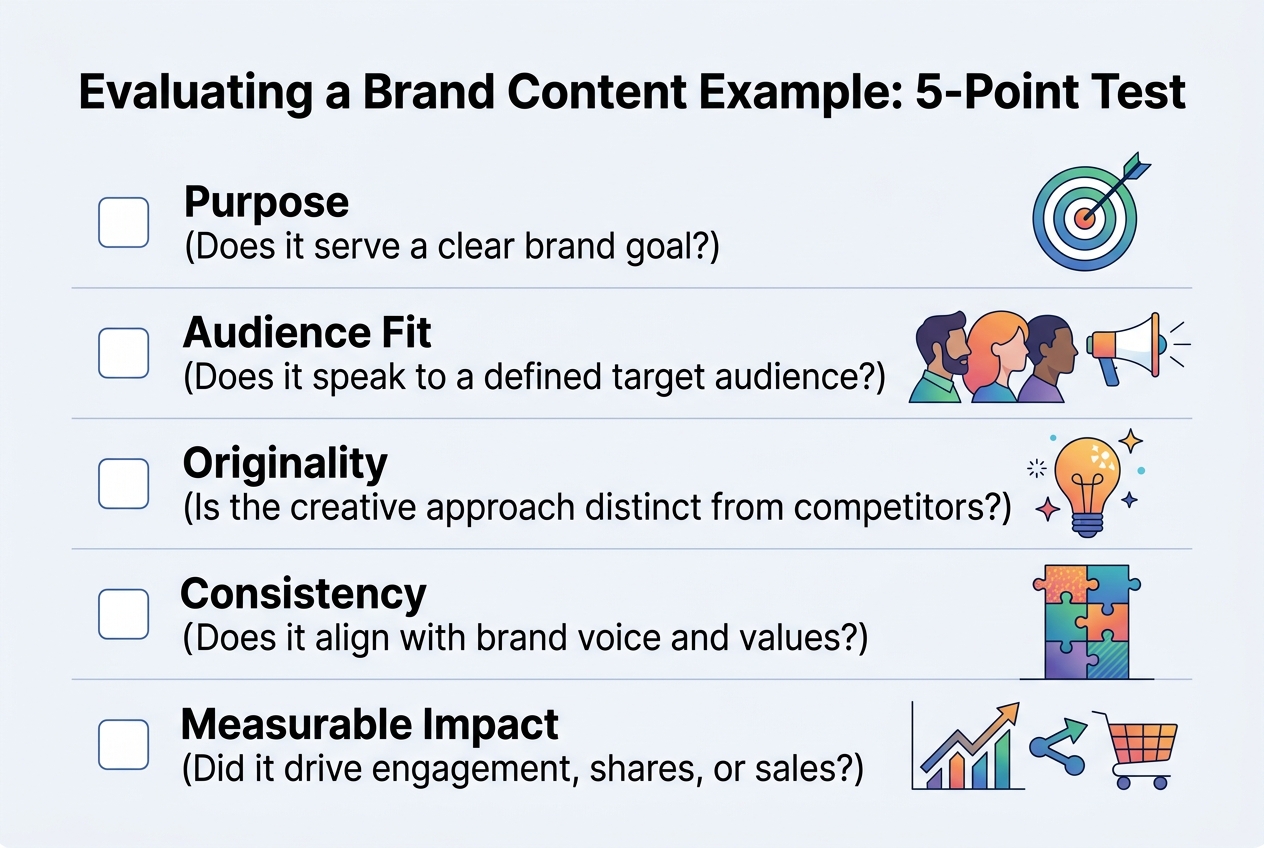
Start with craft. Is the idea actually original, or is it a repackaged trend? Then check production value against budget realism, and ask if the message actually connects to the brand or just borrows attention. After that, look at distribution fit, then measurable impact, then whether it still feels relevant years later. Here's a simple way to score any example on those four fronts.
| Criteria | What to Look For | Red Flag |
|---|---|---|
| Message-to-brand fit | The story clearly ties back to what the company sells or believes | Clever content, but you forget who made it |
| Platform fit | Format matches where the audience actually spends time | A 12-minute film crammed into a 15-second Reel slot |
| Measurable impact | Shares, press mentions, or a documented sales lift | Vague claims like "went viral" with no numbers |
| Longevity | Still referenced or shared three-plus years later | Felt dated within a single news cycle |
Distribution matters more than people admit. A brilliant film wasted on the wrong channel is just an expensive video nobody watches; this The 10 Best Ways to Use Branded Content breakdown covers channel-matching in more depth. If you're vetting execution partners, the Content Creation Agency page from Marz Agency is worth a look for how a full-service ecommerce-focused shop scopes campaigns. And if you're troubleshooting the technical side of publishing, the testing icon guide dev fixture is a handy reference. Score honestly. Most campaigns fail one column.
12 Standout Brand Content Examples Worth Studying
Legacy Campaigns That Set the Standard
Some campaigns just don't age out. They get studied in marketing classes a decade later because the mechanics still work. Here's a rundown worth revisiting before you copy anyone's playbook.
- Dove's Real Beauty Sketches and #ShowUs turned a simple experiment — strangers describing women to a sketch artist — into one of the most-watched branded videos ever, then extended the idea into a crowdsourced image library that outlives any single video.
- The LEGO Movie franchise proved a toy company could produce actual feature films people paid to see, not ads disguised as content, which is a much harder trick than it sounds.
- Honda's OK GO music video for "Needing/Getting," built around a car rigged to play instruments across a desert lot, and the earlier Battle of the Bands stunt showed that engineering itself can be the story.
- GE's science fiction podcast series, "The Message," dressed up a tech brand as a mystery thriller and hooked listeners who had zero interest in turbines.
- Red Bull's athletic stunt content, from the Stratos space jump to endless extreme-sports films, basically built a media company that happens to sell a drink.
- Guinness storytelling ads, especially the "Surfer" spot, made patience itself the punchline — good things come to those who wait, and so does good beer.
If you want a broader gallery of these older wins next to fresher work, 18 Memorable Content Marketing Examples That Made an ... is a solid companion read.
Newer Campaigns Reshaping the Playbook
The newer wave leans less on spectacle and more on community, utility, and format experiments. Some of it will age well. Some of it won't. Worth watching either way.
- GQ's "My First Million" video series hands the mic to founders and creators, turning a men's lifestyle brand into a legitimate business-media source.
- Etsy's editorial blog platform treats maker stories and design trends as content in their own right, not just a funnel to the shop.
- Microsoft's "Make What's Next" campaign spotlighted women inventors overlooked by history, tying brand values to a real cultural gap instead of a generic tagline.
- SodaStream's "Join a Revolution" reframed a kitchen gadget as an environmental stance, which is a bold repositioning for a fizzy-water machine.
- Knorr's Yummy Ks social campaign chased Gen Z attention with short, snackable food content built for feeds, not TV slots.
- Salesforce's Salesblazer community content turns actual customers and sales professionals into the storytellers, which is a different bet than hiring a studio.
Notice the pattern here isn't polish. It's specificity. One quick check before you borrow ideas: audit your own site structure first, since a broken link or a page that's not a valid slug 123 undercuts even the best story sitting behind it.
Common Threads Across These Campaigns
Why Restraint Often Outperforms a Hard Sell
Look closely at the twelve examples above and a pattern emerges fast: the strongest work leads with a feeling, not a pitch. The brand shows up late, sometimes only in a small logo tucked into a closing frame. Readers connect with the story first. The company earns attention second. That order matters more than most marketers admit, and it's the single biggest reason these pieces get shared instead of scrolled past.
Format choice matters just as much as message. A campaign built for a fifteen-second vertical video won't land the same way as a long-form editorial piece, so the smart teams behind these examples picked the format their audience already lives in, rather than forcing a square peg into a round feed. That's the same discipline covered well in this rundown of Branded Content Examples, which stresses fit over flash.
Visual identity carries the thread through every touchpoint, too. Same type treatment, same color logic, same tone of voice, whether it's a newsletter or a billboard. And in every case, the team let the creative idea outshine the sales message. Most brands can't resist tacking on one more CTA. The best ones resist that urge entirely.

Steps for Building Your Own Brand Content Strategy
A Practical Workflow From Idea to Launch
Most brand content fails before a single frame gets shot. Why? Because teams start with the product, not the person watching. A better approach follows a sequence, and each step builds on the last. Skip one and you'll feel it later, usually at the worst possible moment. Here's the order that actually works, laid out plainly.
| Step | Focus | Key Question | Typical Time |
|---|---|---|---|
| 1. Audience Insight | Human tension, not features | What does this person actually struggle with? | 1–2 weeks |
| 2. Format Choice | Film, podcast, editorial, interactive | Where does this story land best? | 3–5 days |
| 3. Small Prototype | Cheap, fast test | Does anyone actually care? | 1–3 weeks |
| 4. Distribution Plan | Seeding, partners, paid push | Who shares this on day one? | 2–4 weeks |
| 5. Success Metrics | Qualitative + quantitative | What counts as a win? | Ongoing |
Notice the order. Insight comes before format, and format comes before spend. Many local businesses reverse this — they pick a shiny format first, then hunt for an audience to fit it. That's backwards, and it's expensive. Prototype cheaply: a five-minute video, a single podcast episode, one long-form article. See what resonates before you scale the budget. For a broader look at how established teams sequence this work, the Best Branded Content | Top Digital Agency Examples roundup is worth a read. Finally, track both hard numbers and honest feedback. Views tell you reach; comments tell you whether it landed. You need both.
Branded Content Formats Compared: Film, Podcast, Editorial, and Social
Choosing the Right Format for Your Team's Resources
Every format asks something different of your budget and your patience. Film looks great in a pitch deck. It also costs the most and ages fastest once the cultural reference expires. Podcasts build trust slowly, which is fine if you're not chasing quarterly wins. Editorial and social sit at opposite ends of shelf life, and that gap matters more than most teams plan for.
| Format | Typical Budget | Shelf Life | Best Reach Pattern |
|---|---|---|---|
| Branded Film | High ($20K+) | 6–12 months | Burst, then fades fast |
| Podcast Series | Moderate | 2–3 years | Slow, loyal, compounding |
| Editorial/Magazine | Low-Moderate | 3–5+ years (SEO-driven) | Steady, searchable, evergreen |
| Social Content | Low | Days to weeks | Fast spike, quick drop-off |
B2B brands usually lean toward podcasts and editorial. Long sales cycles need repeated, credible touchpoints, not a one-off spectacle. Consumer brands, meanwhile, get more mileage from film and social, where emotion and speed win attention quickly. Neither approach is wrong. It's just a resourcing decision dressed up as a creative one.
This is where design-led publications and magazines earn their spot as a hybrid. They carry editorial's durability but borrow film and social's visual polish, which is exactly why so many brands now fund niche magazines instead of one-off campaigns. For a broader survey of how these formats get executed well, 10 Best Branded Content Examples and How to Create ... is worth a read. Pick the format your team can sustain. Not the one that just looks impressive today.
Where to Keep Discovering Fresh Brand Content Examples
Staying Current Through Newsletters and Editorial Archives
The twelve examples covered earlier won't stay relevant forever. New campaigns launch every week, and the brands doing this well tend to move fast. That's why it pays to follow publications that track animation, graphic design, illustration, photography, architecture, and product design as ongoing beats, not one-off trend pieces. A good editorial team spots patterns before they hit mainstream marketing blogs.
A curated newsletter is the easiest way to keep pace without checking a dozen sites daily. You get campaigns delivered as they launch, often with context on why they work, straight to your inbox. No scrolling, no guesswork. If you want a broader primer on the category itself, Branded Content In 2021: Everything You Need To Know is a solid refresher on terminology and format before you dig into current examples.
Editors and contributors who write about creative industry trends are worth engaging directly, too. Many respond to questions, reference sources, or point you toward earlier coverage you'd never find through search alone. That kind of access is undervalued.
Categorized archives matter more than they get credit for. Searching by discipline, say, product design or illustration, lets you build a mental library of what's already been tried. Researching past campaigns this way keeps you from pitching an idea that ran three years ago under a different brand name. Most people skip this step. It shows.
If these brand content examples have you thinking differently about your own creative storytelling, the team at RankPush Test Blog would love to hear from you—whether you're a designer with a project to share or a writer looking to contribute. Stop by their Brooklyn home base at 144 N 7th St. #536, or reach out through their dedicated contributor inquiry channel to start the conversation. Better yet, subscribe to their newsletter so you never miss the next piece of great design coverage.